 |
DISC Training Workshops |
       |

DISC Training Videos from Roger Reece
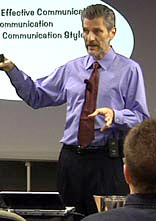
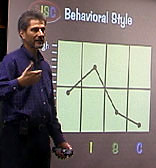
See a selection of clips from recent DISC-training seminars and group-coaching workshops from Roger Reece Seminars. The DISC Behavioral-Style Model is a revelatory tool for interpersonal communication and behavior coaching; Roger is able to present the DISC model as both fundamental and immediate. Roger is an adept trainer of DISC to workshop groups large and small, and we also offer certification programs to other trainers, who wish to integrate DISC into the general culture of their own organizations.
Don't forget to also visit our video channel on Youtube: you'll find dozens more clips spanning nearly every subject we cover available there.

DISC Styles: Perceptions & Reactions
It is important to understand that other people's perceptions
of you may be far, far removed from what you intend to
convey, particularly in times of stress. Different behavioral
styles have very different ways of seeing the world; and
frequently, what is intended by one person's behavior
is not judged the same way by another. This is fertile
grounds for misunderstandings; it can make an already-burgeoning
conflict even worse.
When you perceive somebody in a negative way, it often
determines how you will interact with them. In a team,
the same behaviors and negative reactions can happen over
and over again and cause team-members to form negative
perceptions of one another. If these daily misunderstandings
and clashes are allowed to persist between two people
over time, without ever being addressed, they can cause
those people to lose respect for one another - and that
is the worst thing that can happen in a team.
DISC Styles and Difficult Behavior, Part 1
Every behavioral style has its own natural strengths -
those things that just seem to come naturally to a person
- as well as a complementary set of typical weaknesses.
But what is natural for a person is not the only thing
they can ever be good at. The difference is just that
it requires a conscious effort and willingness to adapt
in order to develop a skill that is not intuitive to you.
It takes a commitment to making that practice a priority,
as well as the conviction that developing this new skill
really deserves your attention, either in your current
environment or for where you would one day like to be.
DISC Styles and Difficult Behavior, Part 2
Your behavioral style is a roadmap - not only to your
own behaviors and tendencies, but also to the behaviors
in others that are most likely to be difficult for you.
Each style has its opposite: for 'D's, it's the 'S' style,
and vice versa; and for 'C's and 'I's, it's the same thing.
In a deeper sense, the people of your opposite style are
the ones who have the most they could teach you; day to
day, however, those same people are the ones who are the
most likely to annoy you the worst. The good news is that
this same understanding of your differences is your guide
to resolving these clashes, for the good of the team and
for your respect levels to your teammates.
DISC Styles and Difficult Behavior, Part 3
One of the biggest personality differences in styles is
in the area of pace. This probably causes the most problems
in the interactions between 'S's and 'D's. 'D's are fast-paced;
they are bottom-line oriented, and sometimes brusque;
they want to do things as quickly as possible. 'S's, on
the other hand, prefer a slower pace: they want more detail
in instructions; they like to spend more time in order
to absorb the subtext, to be sure that they deliver what
the other person expects. So for an 'S', the rapid pace
and forceful demeanor of a 'D' can hit them like a tornado
- and by the same token, for the 'D', the extra time and
conversation an 'S' demands can be excruciating!
How to Be More Assertive
Assertiveness is a behavior. So is non-assertiveness.
These behavior patterns are all habits: we begin practicing
them very early on, and by the time we're adults we've
gotten really good at doing one or the other. They have
become our comfort zone, in other words, and we will resist
doing anything different. But leadership development depends
on breaking out of our comfort zones to begin practicing
the skills we want to develop, not just the skills
we already have. It begins by acknowledging that changing
behavior patterns is a hard thing to do, and then choosing
to do what is hard over what comes easy. It also depends
on recognizing that our behavioral style is not our identity:
what we do is not who we are. Leadership is deciding on
what we would like to do, and then choosing to practice
those behaviors every day and every chance we get.
DISC Behavioral Style Model Overview
How the the DISC Model divides into four behavioral styles
comes by measuring two scales of behavior. The first scale
divides extroverted or introverted behavior; and one of
the things that goes along with this is pace. Pace relates
to the quickness of the way you speak, as well as how
quickly you jump into situations. Pace informs the words
you choose and even the way you form sentences, and it
also relates to decision-making and impulsivity. A simple
way to put it might be to say that an introvert likes
to think before speaking or acting, generally, and an
extrovert will be more comfortable "thinking out loud,"
or "acting on instinct," so to speak. DISC also compares
task-oriented vs. people-oriented behavior at the same
time. This is about what a person is more likely to focus
on in a situation: the way they like to look at things
and how they will approach problem-solving. "Task-oriented"
people tend to be more pragmatic and practical, focused
on getting the job done; "people-oriented" people are
more attuned to the feelings and interactions of the people
involved, and view problems in terms of the dynamics of
the team engaged in solving them. Where a person lands
along these two scales shows how strongly they identify
as either 'D,' 'I,' 'S,' or 'C,' and it also helps them
to see how they might be influenced by or react to each
of the four DISC styles.
DISC Styles Are Like Languages
Every behavioral style is like a different language, in
much the same way that regional dialects can sometimes
make it hard for two people speaking the same language
to understand one another. In a way, the "languages" of
the four behavioral styles of DISC are much the same.
We assume that because we are using the same language,
everyone understands what we're saying. But the fact is,
effective communication with people of differing styles
is often not about what you say, but how you say it. We
communicate through things like tone of voice, and other
non-verbal signals which can be easily misinterpreted,
according to the behavioral "type" of the other person.
The question of whether what is picked up is projection
doesn't matter - perception is in the mind of the perceiver.
And if you want to communicate effectively, it is your
responsibility to take a leadership role in continually
monitoring that the input and output you send and receive
are a match with the message intended.
DISC Styles & Team Diversity
Working with a diverse team involves interacting with
a variety of thinking, communication and behavioral styles.
In other words, everyone is not like you. The lesson is
important and bears repeating: Forgive other people for
not being you. If everyone in the world thought like you,
acted like you and talked like you, the world wouldn't
function well at all. We need the diversity of thinking,
behavior and problem-solving we find at work, at home,
and everywhere around us; and if we accept this is true,
we realize that we need to learn how to get along with
people who are very different than us. If we want to benefit
from the strengths of people who think in very different
ways, we have to learn how to work as a team. And if we
want to be a good team we cannot avoid the conflicts and
problem behaviors that inevitably come up.
Avoidance doesn't work. You learn to communicate with
a person by trying different ways of talking or interacting
with them, until you get the positive response you were
seeking. If you haven't done that, you haven't really
tried to communicate. And until you succeed at that, you
haven't communicated at all.
Your DISC Style Can be a Blind Spot
Our blind spots cause our miscommunications. When you're
in a conversation with someone and trying to communicate,
it's important to remember that all of us have certain
blind spots that obscure or distort our perception in
unpredictable ways. The blind spots causing someone else's
problem behavior may be obvious to you, but you can't
just tell somebody why they need to change. You'll only
encounter resistance. This is a particular challenge for
people of direct behavior styles: when they see something
wrong that the other person is just not getting, the temptation
for them is to get very direct and blunt; their controlling
urges start to come out. But each behavior style has its
own areas of inattentional blindness that handicap a person's
ability to focus on the positive outcomes of communication
and teamwork, and instead spark resistance, blame and
defensiveness in the other person and themselves.
DISC Behavioral Styles & Team Ecology
Improving team ecology with DISC: When you feel good about
the people that you work with and the environment that
you're in, it really makes a difference. A work environment
that has a sound ecology - that is, where people communicate
well, where teams get along, where employees feel a sense
of accomplishment - gives everyone a sense of value in
their work that raises productivity as a whole by substantial
margins. It doesn't happen by accident, and it's a lot
easier to improve on when there's already a solid foundation
of teamwork and morale - to go from good to great, in
other words. But a shared understanding of the principles
of DISC behavioral and communication styles gives your
team a new terminology to use with each other: instead
of derogatory labels or loaded terms that can feel like
value-judgements, your team shares a vocabulary that understands
the wide variety of communication styles, and assumes
the positive intent behind each person's behavior.
|
|
|
|